
Home · Guides
How to pick an offer that drives repeat purchases
The best first offer is the one that creates a second order, not the one with the highest first-order margin. Pick the product with the highest repeat rate, price the first order to remove doubt, and build the offer so that reordering is the natural next step.
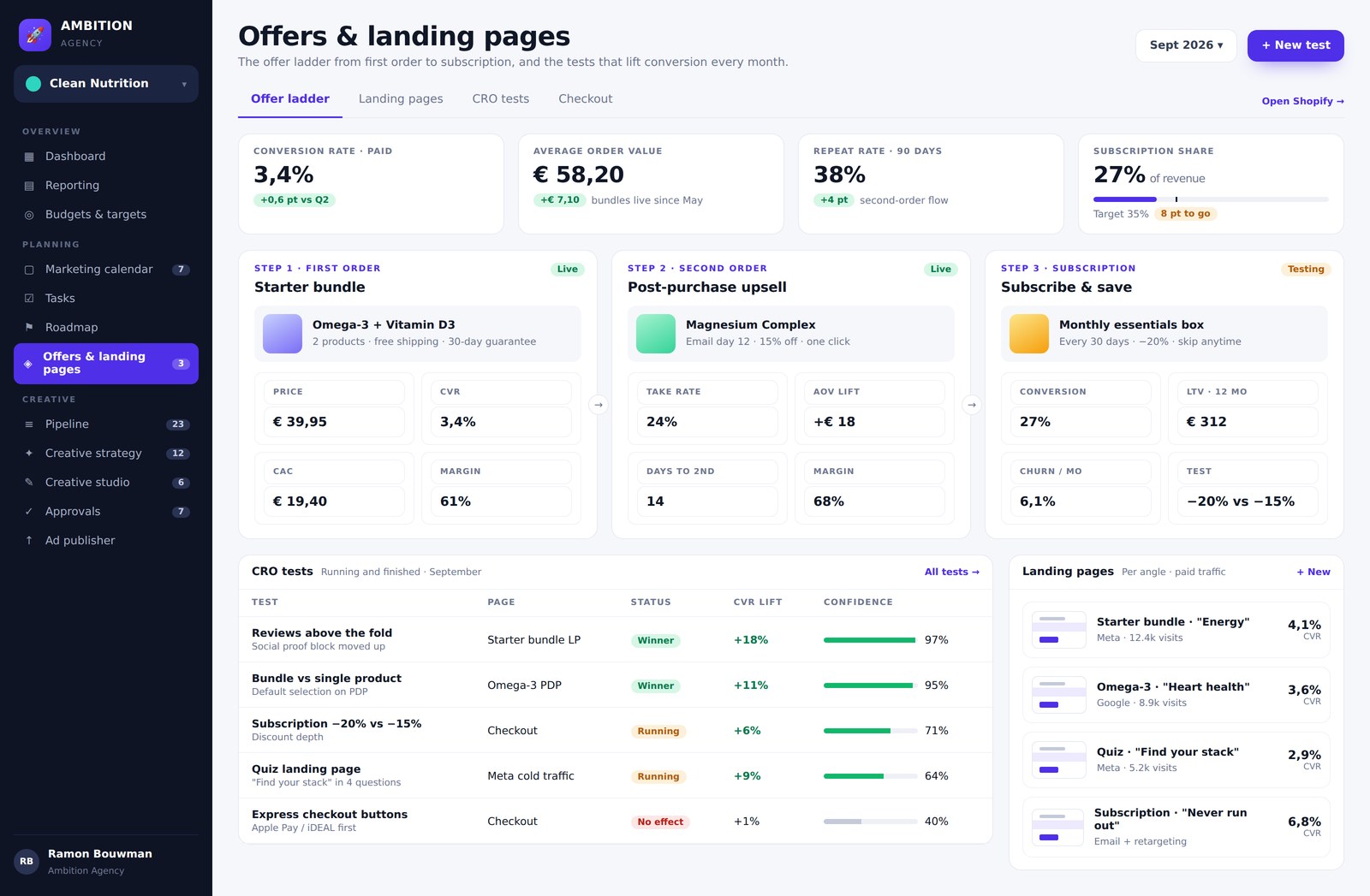
Start with the product, not the discount
Most brands pick an offer by asking "what can we discount?" The better question is "which product turns first-time buyers into customers?" Your Shopify data answers that: for each product, look at the share of first-time buyers who place a second order within 90 days. The product with the highest repeat rate is your entry product, even if it is not your bestseller.
A supplement brand we work with had a multivitamin as bestseller and an omega-3 as a mid-seller. Omega-3 buyers reordered 38% of the time, multivitamin buyers 22%. The omega-3 became the front-door offer, and 90-day revenue per new customer rose by a third.
Four offer types and when they work
| Offer | Best for | Effect on first order | Effect on repeat |
|---|---|---|---|
| Bundle (2+1, 3+2) | Consumables with a fixed usage rhythm | Higher order value, slightly lower conversion | Strong: customer builds the habit |
| Trial at cost (first tub €9.95) | Products that need to be tried to be believed | Very high conversion, negative margin | Strong if the product delivers |
| Subscribe-and-save (−15%) | Brands with a proven product and clear cadence | Lower conversion on cold traffic | Very strong, but churn after order 2 decides it |
| Percentage discount (−30%) | Clearing stock, not acquisition | High conversion, trains price sensitivity | Weak: attracts bargain hunters |
Offer types for repeat-purchase products, from our accounts.
Price the first order to remove doubt, not to give margin away
A first-time buyer has one question: will this work for me? The offer should answer that, not shout a percentage. A 2+1 bundle answers it (enough for a real trial). A first tub at cost answers it (nothing to lose). A 40% discount on a single unit does not; it just teaches the customer to wait for the next one.
Set a floor: the first order may run below break-even only if the 90-day value covers it. If 38% reorder at €25 margin each, a first order can lose about €9 and still be profitable within the quarter.
Build the landing page around the offer
A product page has to do everything: inform, compare, reassure, sell. A landing page has one job: make this offer obvious. Above the fold: the offer, the price, the proof (rating, customers, reorder rate) and one button. Below: the three objections your reviews mention most, answered. Then the offer again.
We always test the landing page next to the existing product page with the same traffic, for at least two weeks or 100 orders. The landing page usually wins by 15 to 30% on conversion, but not always; when it loses, the offer was wrong, not the page.
Improve the offer and the page every month
An offer is a hypothesis. Each month we look at three numbers: conversion rate of the page, average first-order value, and 90-day repeat rate of the customers it brought in. If conversion is high but repeat is low, the offer attracts bargain hunters; raise the floor. If conversion is low but repeat is high, the page is the problem; rework the proof and the objections. One change at a time, tested against the current version.